1.What are the types of economies?
There are four types of economic systems traditional economy, market economy, command economy, and mixed economy.
- Traditional economy
Vast portions of the world still function under a traditional economic system. These areas tend to be rural, second- or third-world, and closely tied to the land, usually through farming. In general, in this type of economic system, a surplus would be rare. However, they do lack access to technology and advanced medicine.
*Surplus: an amount, quantity, etc., greater than needed.
- Command economic system
Since the government is such a central feature of the economy, it is often involved in everything from planning to redistribute resources. A command economy is capable of creating a healthy supply of its resources, and it rewards its people with affordable prices. In a command economy, it is theoretically possible for the government to create enough jobs and provide goods and services at an affordable rate. However, in reality, most command economies tend to focus on the most valuable resources like oil.
Advantages: If executed correctly, the government can mobilize resources on a massive scale; Which can provide jobs for almost all of the citizens.
Disadvantages: There is a lack of innovation since there is no need to take any risk. Workers are also forced to pursue jobs the government deems fit.
- Market Economic System
In this type of economy, there is a separation of the government and the market. This separation prevents the government from becoming too powerful and keeps their interests aligned with that of the markets. However, no truly free market economy exists in the world. For example, while America is a capitalist nation, their government still regulates (or attempts to control) fair trade, government programs, honest business, monopolies, etc. Hong Kong has been seen as an example of a free market society.
Advantages: Consumers pay the highest price they want to, and businesses only produce profitable goods and services. There is a lot of incentive for entrepreneurship. Constant innovation as companies compete to provide better products for consumers.
Disadvantages: Since the market is driven solely by self-interest, economic needs have a priority over social and human needs like providing healthcare for the poor. Consumers can also be exploited by monopolies.
- Mixed economy system
This economic system is a cross between a market economy and command economy. In the most common types of mixed economies, the market is more or less free of government ownership except for a few key areas like transportation or sensitive industries like defence and railroad. However, the government is also usually involved in the regulation of private businesses. The idea behind a mixed economy was to use the best of both worlds – incorporate policies that are socialist and capitalist.
Advantages: Governments can create safety net programs like healthcare or social security. In a mixed economy, governments can use taxation policies to redistribute income and reduce inequality.
Disadvantage: A common problem is that the state run industries are often subsidised by the government and run into large debts because they are uncompetitive.
- As Mr. Cosidó noted in his report, the economies of the major OECD countries, including in Europe, are all expected to continue to grow in the next 18 months, albeit at a somewhat slower pace. Emerging economies as a group continue to excel, with China and India in particular remaining major drivers of the global expansion.But, while the near-term global outlook seems rather positive, I would like to mention four risks which could threaten such a scenario:
-
Oil prices – both the OECD and its sister organisation, the International Energy Agency (IEA), are working to help countries address both the short-term and long-term challenges related to energy prices, security of supply and alternative sources. The recent drop in prices is quite welcome.
-
External imbalances – current account imbalances have reached unprecedented levels in the US, China, Japan and other Asian countries, as well as in most oil-exporting countries. Although these imbalances have not yet caused much disruption, they cannot continue indefinitely. A disorderly unraveling could be disruptive and could deteriorate expectations.
-
The risk of protectionism – we need to support a successful conclusion to the Doha Development Agenda. As OECD research shows, there is room for large gains from further liberalisation in terms of poverty reduction and longer term economic growth world wide. Failure to successfully conclude the Doha round risks unleashing a wave of protectionism from which all would lose. In a similar vein, the resurgence of investment protectionism among OECD countries is a very worrying trend.
-
In some countries where housing prices have increased considerably, the effect of higher interest rates and slower economic growth could have indirect consequences on consumption patterns, and on housing demand itself, which has been one of the drivers of growth.
The challenges of economic growth and development, and the implementation of reforms. (n.d.). Retrieved September 5, 2018, from http://www.oecd.org/general/thechallengesofeconomicgrowthanddevelopmentandtheimplementationofreforms.htm
-
- Provides a well functioning legal and political system:-
Any economy facing political or economic turmoil is not conducive to economic growth since it has very little trust in the economy. Moreover, there is uncertainty in the economy and people are also unwilling to invest.The government needs to make sure that there is a stable political environment. It’s very important on the part of the government to provide good legal and political framework. - Plays regulatory role to provide a competitive market:-
There should be certain regulations to ensure that the economy does not drift to the monopolistic situation.The government needs to think about trade policies with foreign countries, regulation on natural resources available in our country etc. - Stimulate the economy by increasing the government spending:-
This was one of the philosophies given by one of the renowned economist John Maynard Keynes. He was of the view that government’s role is very important when the economy is in recession or depression like situation and the government should increase spending to have a pickup in the economic activity. - Keep economic inequality in check:-
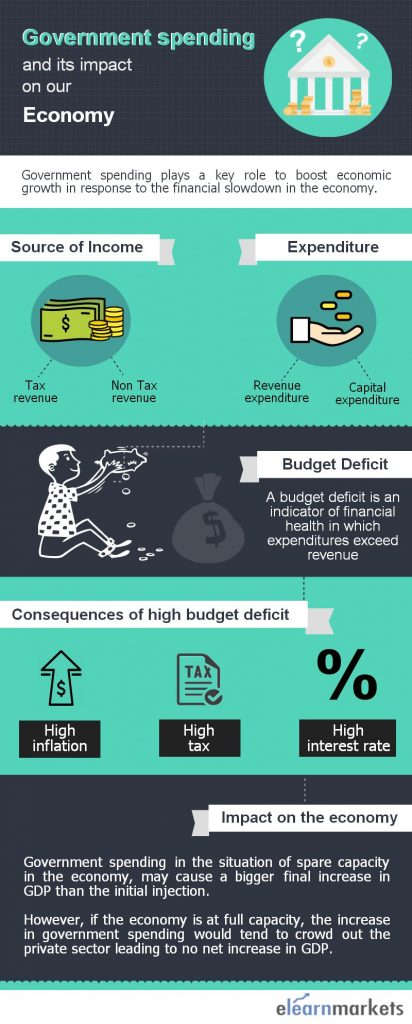
Great disparity amongst masses may lead to a certain amount of unrest in the economy. This disparity causes a certain amount of imbalances in goods and capital market. Hence, the government needs to provide schemes and policies via taxes or social spending to keep inequality in check.Before understanding how does government spending affect the economy, let’s first understand how government earns and spent its money.
The main sources of income for the government are Tax and Non-Tax revenue. Taxes include Income tax, Corporation tax, and Indirect taxes while the Non-Tax revenue comes from Public Sector units like income from Railways or Public sector Banks etc.
How Does Government Spending Affect The Economy. (2018, July 25). Retrieved September 5, 2018, from https://blog.elearnmarkets.com/how-does-government-spending-affect-the-economy/

 jacintaspblstudy.blog