Government regulation of the national economy


1.What are the types of economies?

There are four types of economic systems traditional economy, market economy, command economy, and mixed economy.

  •  Traditional economy

Vast portions of the world still function under a traditional economic system. These areas tend to be rural, second- or third-world, and closely tied to the land, usually through farming. In general, in this type of economic system, a surplus would be rare. However, they do lack access to technology and advanced medicine.

*Surplus: an amount, quantity, etc., greater than needed.

  •  Command economic system

Since the government is such a central feature of the economy, it is often involved in everything from planning to redistribute resources. A command economy is capable of creating a healthy supply of its resources, and it rewards its people with affordable prices. In a command economy, it is theoretically possible for the government to create enough jobs and provide goods and services at an affordable rate. However, in reality, most command economies tend to focus on the most valuable resources like oil.

Advantages: If executed correctly, the government can mobilize resources on a massive scale; Which can provide jobs for almost all of the citizens.

Disadvantages: There is a lack of innovation since there is no need to take any risk. Workers are also forced to pursue jobs the government deems fit.

  • Market Economic System

In this type of economy, there is a separation of the government and the market. This separation prevents the government from becoming too powerful and keeps their interests aligned with that of the markets. However, no truly free market economy exists in the world. For example, while America is a capitalist nation, their government still regulates (or attempts to control) fair trade, government programs, honest business, monopolies, etc. Hong Kong has been seen as an example of a free market society.

Advantages: Consumers pay the highest price they want to, and businesses only produce profitable goods and services. There is a lot of incentive for entrepreneurship. Constant innovation as companies compete to provide better products for consumers.

Disadvantages: Since the market is driven solely by self-interest, economic needs have a priority over social and human needs like providing healthcare for the poor. Consumers can also be exploited by monopolies.

  • Mixed economy system

This economic system is a cross between a market economy and command economy. In the most common types of mixed economies, the market is more or less free of government ownership except for a few key areas like transportation or sensitive industries like defence and railroad. However, the government is also usually involved in the regulation of private businesses. The idea behind a mixed economy was to use the best of both worlds – incorporate policies that are socialist and capitalist.

Advantages: Governments can create safety net programs like healthcare or social security. In a mixed economy, governments can use taxation policies to redistribute income and reduce inequality.

Disadvantage: A common problem is that the state run industries are often subsidised by the government and run into large debts because they are uncompetitive.

Agarwal, P. (2017, December 24). The Four Types of Economies | The Intelligent Economist. Retrieved September 3, 2018, from https://www.intelligenteconomist.com/types-of-economies/
2. Which challenges does the economy face?
  • As Mr. Cosidó noted in his report, the economies of the major OECD countries, including in Europe, are all expected to continue to grow in the next 18 months, albeit at a somewhat slower pace. Emerging economies as a group continue to excel, with China and India in particular remaining major drivers of the global expansion.But, while the near-term global outlook seems rather positive, I would like to mention four risks which could threaten such a scenario:
    • Oil prices – both the OECD and its sister organisation, the International Energy Agency (IEA), are working to help countries address both the short-term and long-term challenges related to energy prices, security of supply and alternative sources.  The recent drop in prices is quite welcome.
    • External imbalances – current account imbalances have reached unprecedented levels in the US, China, Japan and other Asian countries, as well as in most oil-exporting countries.  Although these imbalances have not yet caused much disruption, they cannot continue indefinitely.  A disorderly unraveling could be disruptive and could deteriorate expectations.
    • The risk of protectionism – we need to support a successful conclusion to the Doha Development Agenda.  As OECD research shows, there is room for large gains from further liberalisation in terms of poverty reduction and longer term economic growth world wide.  Failure to successfully conclude the Doha round risks unleashing a wave of protectionism from which all would lose.  In a similar vein, the resurgence of investment protectionism among OECD countries is a very worrying trend.
    • In some countries where housing prices have increased considerably, the effect of higher interest rates and slower economic growth could have indirect consequences on consumption patterns, and on housing demand itself, which has been one of the drivers of growth.

    The challenges of economic growth and development, and the implementation of reforms. (n.d.). Retrieved September 5, 2018, from http://www.oecd.org/general/thechallengesofeconomicgrowthanddevelopmentandtheimplementationofreforms.htm

3. How does the government boosts the economy?
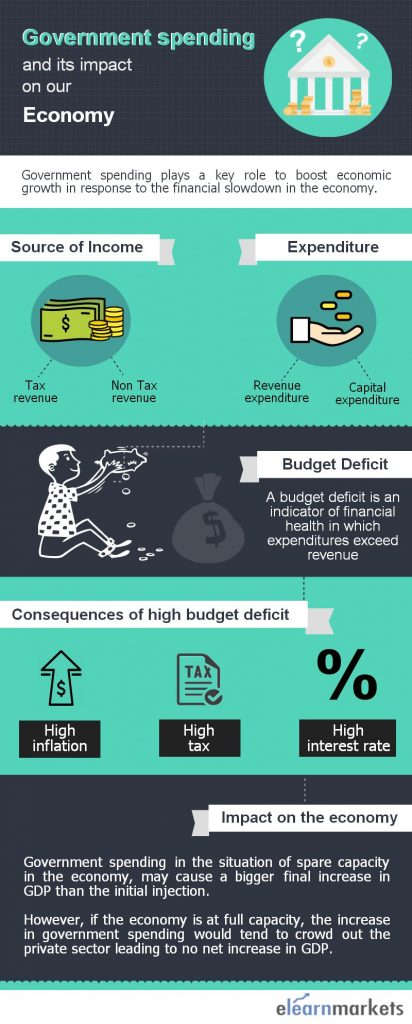
                government spending impact on our economy
  • Provides a well functioning legal and political system:-
    Any economy facing political or economic turmoil is not conducive to economic growth since it has very little trust in the economy. Moreover, there is uncertainty in the economy and people are also unwilling to invest.The government needs to make sure that there is a stable political environment. It’s very important on the part of the government to provide good legal and political framework.
  • Plays regulatory role to provide a competitive market:-
    There should be certain regulations to ensure that the economy does not drift to the monopolistic situation.The government needs to think about trade policies with foreign countries, regulation on natural resources available in our country etc.
  • Stimulate the economy by increasing the government spending:-
    This was one of the philosophies given by one of the renowned economist John Maynard Keynes. He was of the view that government’s role is very important when the economy is in recession or depression like situation and the government should increase spending to have a pickup in the economic activity.
  • Keep economic inequality in check:-
    Great disparity amongst masses may lead to a certain amount of unrest in the economy. This disparity causes a certain amount of imbalances in goods and capital market. Hence, the government needs to provide schemes and policies via taxes or social spending to keep inequality in check.Before understanding how does government spending affect the economy, let’s first understand how government earns and spent its money.

The main sources of income for the government are Tax and Non-Tax revenue. Taxes include Income tax, Corporation tax, and Indirect taxes while the Non-Tax revenue comes from Public Sector units like income from Railways or Public sector Banks etc.


How Does Government Spending Affect The Economy. (2018, July 25). Retrieved September 5, 2018, from https://blog.elearnmarkets.com/how-does-government-spending-affect-the-economy/



MANAGING ACTIVITIES

  1. What are the types of organisational structure?

Line, functional and line-and-staff structures It’s a very rigid structure, with little information exchange, typical of bureaucratic companies in which there is little collaboration.

Project-based structure highly dynamic and creative companies – such as software developers, architecture firms, special industrial equipment installation projects and event organization companies

Matrix structures This structure is widely used both by companies that are constantly launching new products and marketing campaigns, for example, and by companies that have project-based structures, but also believe that functional supervision is necessary and important.

5 Organisational Structure Examples | Which to use? (2018, March 28). Retrieved August 28, 2018, from https://www.heflo.com/blog/business-management/small-business-organizational-structure-examples/

  1. What are the processes in the internal structure?

Function: Functional organisation meant that a company is divided into broad sectors each with its own particular specialism or function, for example, marketing, accounts or human resources. Traditionally, functional organisation is hierarchical, with some form of line management.

Product: When a large organisation produces a range of different products, it might find it convenient to create an organisational structure based on product lines. A great advantage of this form of structure is that divisions can concentrate on their own market areas. It also becomes possible to assess the profitability and effectiveness of each sector. At the same time it is still possible to share expertise between divisions and to share combined services such as a combined transport fleet.

Process: The advantages of organizing on a process basis are that, it is possible to set up teams of similar minded specialists. It becomes easy to identify points in the production process at which things go well or badly. It is easy to introduce new technology at a given stage of production

Geographical area: There are a number of advantages of organising on a geographical basis: Setting up distinct regional divisions makes it possible to respond quickly to local needs, issues and problems. Setting up national and regional divisions makes it possible to tailor the operation of an organisation to local conditions. Differences would include those of language, law and custom. Local knowledge is best gained by hiring local specialists.

Type of customer: The advantages of organising in a pattern based on having different sets of customers are, different types of customers can be dealt with by separate departments. Customers will be more inclined to deal with a business with departments concentrating on their particular needs. It is easier to check on the performance of individual products.

LLP, B. C. (n.d.). Strategy theory. Retrieved from https://businesscasestudies.co.uk/business-theory/strategy/internal-organisation.html

  1. Which are the main departments in a company?

A typical business organisation may consist of the following main departments or functions:

  • Production: The Production function undertakes the activities necessary to provide the organisation’s products or services. Production planning and scheduling, control and supervision of the production workforce, managing product quality, maintenance of plant and equipment, control of inventory, deciding the best production methods and factory layout.
  • Research and Development: Research and Development, concerning the implications of product design for production methods and cost.
  • Purchasing: The Purchasing function is concerned with acquiring goods and services for use by the organisation. Quantity, quality and price.
  • Marketing: Marketing, concerning desired product functionality, appearance, quality, durability and so on.
  • Human Resource Management: Human Resource Management, concerning staff motivation implications of job design and production methods.
  • Accounting and Finance: Finance, concerning the availability of funds for purchase of new equipment and the acceptability of inventory levels.

Organisations and management accounting. (n.d.). Retrieved from http://www.open.edu/openlearn/money-management/organisations-and-management-accounting/content-section-4.4


CONFLICTS IN GROWING COMPANIES

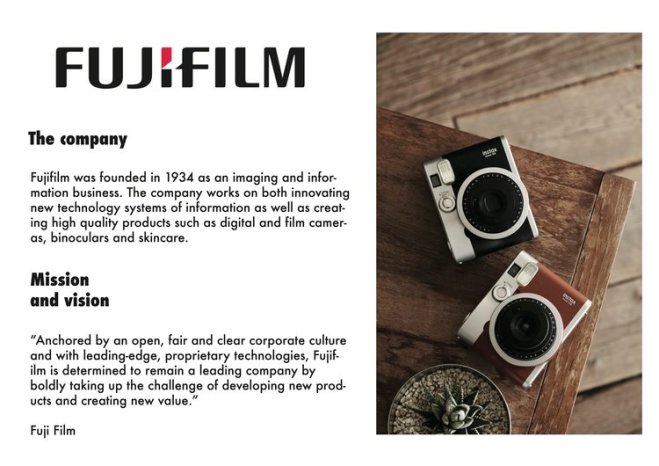
After reviewing a conflict of a big company such as fuji film, our team got to the conclusions that many companies face challenges when it comes to adapting to new generations of customers and the need to satisfy them by innovation in their own products. Many companies do not adjust of implement a good strategy to overcome such challenges. This is why we generated 4 questions that will categorize the problem we were handed in and later on find the ultimate solution for fuji film company and also other companies.

First of all, we need to know the company’s mission, vision statement and their strategy.Benchmarking - CVA6.jpg

A) Benchmarking. (n.d.). Retrieved August 21, 2018, from http://caroline-vanarwegen.squarespace.com/benchmarking/zhg9oru6a3enebzyrg66ppkw2fzhfh


  1. What challenges do a company faces when diversifying?

Throughout the whole process of implementing a new diversification strategy into a company can involve matters like,  diverse culture, formulated policy to support diversification programs not in agreement with implementing strategic decisions made in diversification programs, conflict of the organizational role, leaders being resistant to change, poor coordination between management, other employees and stakeholders.

Firstly, companies might wish to create and exploit economies of scope, in which the company tries to exploit its exciting resources and capabilities in other markets. Companies may also want to use diversification strategy to spread financial risk over different markets and products, so that the entire success of the company is not reliant on one market or product only.

B) ELECTOR, A. M. (2012, November). CHALLENGES OF IMPLEMENTING DIVERSIFICATION STRATEGY AT THE MUMIAS SUGAR COMPANY, KENYA. Retrieved August 21, 2018, from http://erepository.uonbi.ac.ke/bitstream/handle/11295/12287/document(9).pdf?sequence=3.page 3,4,5

Trust of customers, Exportation, Transportation, Marketing, And Research. New market, new product, means more production and more resources. Great investment, and a gamble in risk.

2.What helps a company grow?

C) Moorman, C. (2012, July 02). How Does Your Company Grow? Retrieved August 21, 2018, from https://www.forbes.com/sites/christinemoorman/2012/07/02/how-does-your-company-grow/#565bc13755e3

image#2
Uniqueness (offer a product that no other company can offer), more value (high quality products and high quality service),innovation (always improving their products, and being flexible with image and functions) .
3.What does a company need to overcome challenges?
Leadership: There needs to be agreement from the top of every organisation around priorities, focus, and vision. Without that, it is too easy for conflicting agendas to work their way in

Collaboration: Now a days there are many smart people with different perspectives and experiences. The best way to overcome any organisation challenge is to tap that vast knowledge, working together to solve problems.

Communication: Top management should be reachable to employers for any doubts or any requests. Employees need to stay connected, so events between co-workers, or a platform in which they all connect is a good idea.By getting together and talking – both about work and their lives – it builds both a trusting and productive environment.

Focus: Too often we cease to “shiny object syndrome.” If everything is a distraction, however, nothing can really be accomplished. It is important to identify the end goal, create a plan to make it happen, and then remain focused on that plan moving forward.

Be open-minded: to solutions, different approaches, and new perspectives. Conversations and reflection are key to get to solutions everyone together.

D) Lyons, A. (2017, December 08). 5 Tips for Overcoming Challenges in Company Growth. Retrieved August 21, 2018, from https://www.shiftcomm.com/blog/5-tips-for-overcoming-challenges-in-company-growth/

4.How to expand to other fields within demands and needs of society?
Understand that business depends on society, they determine what they want, and companies based on that will determine what they need. In order to be successful in this field/strategy companies need to first make a research on the market, and then bring something of value, something that no other company has, so that the products becomes a need to society.
Companies are forced to blank out the fact that they command enormous resources that influence the world for better or worse and that their strategies shape the lives of the employees, partners, and consumers on whom they depend.Those firms believe that business is an intrinsic part of society, and they acknowledge that, like family, government, and religion, it has been one of society’s pillars since the dawn of the industrial era. Great companies work to make money, of course, but in their choices of how to do so, they think about building enduring institutions.
F) Kanter, R. M. (2014, November 04). How Great Companies Think Differently. Retrieved August 21, 2018, from https://hbr.org/2011/11/how-great-companies-think-differently

PBL

Solving Hannes problem, We first needed to focus on the bigger problems and which ones could be solved. At last what we focused on, “Competences and skills needed in the International Business”. for this, we all needed to make our own research and answer basic questions so that we each get different points of view and later on get to the ultimate solution for Hannes case.

1-What are the characteristics of a business profile?

Passionate, Risk-taker, Creative, Ambitious, Hard worker, Adaptable, Good planner, Integrity, Good with money, and approachable.

A successful businessmen will always try to achieve more and be responsable for his/her employees, this way they will see mistakes, analyse them and solve them. Also a good businessmen will always guide their employees so they learn themselves.

2-What skills are demanded from an international business profile?

self-discipline, initiative, self- belief, ambition , persistence, action-oriented, cultural intelligence is a must.

Aside from the skills, its also very easy to distinct apart from good and bad businessman. A good one, will always make sure they give a good impression, they make themselves clear, and they study the people they will deal with beforehand.

3-What challenges do International Business face?

disappointment, cultural shock, disagreements,  uncertainty, competition, lack of loyalty.

As they travel, they will face different aspects, such as nature, culture and language. Is their intuition and they adaptability that will differentiate the good businessmen from the bad one.

4-How can an International Business Student can keep up motivation?

Understand that failure is part of the way, and we all learn from mistakes. Engage in your own project and give it your best. Always aim higher, a self competition is healthy to stay focused in your goals.

Sources.

1. Seth, S. (2018, March 14). 10 Characteristics of Successful Entrepreneurs. Retrieved August 15, 2018, from https://www.investopedia.com/articles/personal-finance/101014/10-characteristics-successful-entrepreneurs.asp according to question one, I got answers from here.

2. Conner, C. (2015, July 13). The ‘8 Great’ Challenges Every Business Faces (And How To Master Them All). Retrieved August 13, 2018, from https://www.forbes.com/sites/cherylsnappconner/2013/03/04/the-8-great-challenges-every-business-faces-and-how-to-master-them-all/#7c8e227a3891 This I used for the 3 question answers.

3. M. (2013, July 29). 21 Ways to Keep Your Motivation Flying High. Retrieved August 13, 2018, from https://daringtolivefully.com/keep-your-motivation-high


The Journey Begins

Thanks for joining me!

Good company in a journey makes the way seem shorter. — Izaak Walton

Europe.

Finland
Suomelinna
Frederiksborg or Kronborg castle
Rock church
Didrischen art museum

St. Petersburg
Open doors music concerts in the famous Palace square
Midnight boat tour
Tsarist palaces in Oranienbaum and Gatchina
Parks in Tsarkoe and Pavlosks
Fountains at peterhof

Moscú
Red square
St Basils cathedral
Moscow kremlin
State historical museum
Gum
Tsaritsyno reserve
Novodevichy convent
Izmailovsky market

Tallín
sdf