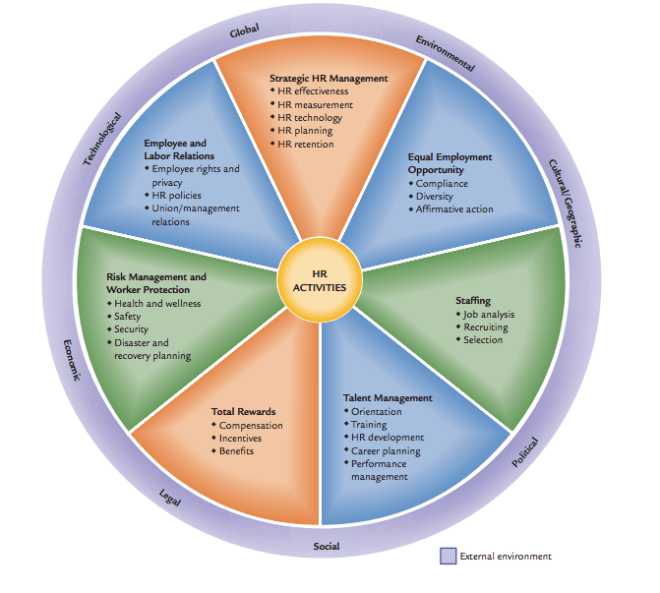
What do HR management does? HR management ensures that human talent is used effectively and effi ciently to accomplish organizational goals.
Meet with the CEO and CFO to plan compensation budgets for the following year.
Discuss with an outside lawyer a racial discrimination complaint by a former employee who has been terminated because of performance problems.
Negotiates with the providers to increase benefits for the company.
Advise an executive on the process for terminating a sales manager whose sales performance and efforts were significantly below the goals set.
Discuss with the other members of the Executive Leadership Team (the CEO, the CFO, and division heads) an employee staffing plan for the following year and ways to reduce employee turnover.
HR MANAGEMENT ROLES
Administrative: Focusing on HR clerical administration and recordkeeping
■ Operational and employee advocate: Managing most HR activities in keeping with the strategy that has been identified by management and serving as employee “champion”
■ Strategic: Helping to define the strategy relative to human capital and its contributing to organizational results
Outsourcing of HR Increasingly, many HR administrative functions are being outsourced to vendors. The HR areas most commonly outsourced are employee assistance (counseling), retirement planning, benefits administration, payroll services, and outplacement services.
HRM CHALLENGES
Employees divided in two: Line or Staff
Line Employee: They are in charge of producing company’s goods and services.
Managers: People who are responsible for how other workers perform in company.
Staff Employee: Support line employees.
Globalization is primarily an economic process of interaction and integration that’s associated with social and cultural aspects. However, conflicts and diplomacy are also large parts of the history of globalization, and modern globalization.
Legislation a law or set of laws suggested by a government and made official by a parlament.
Global Security and Terrorism Another global challenge for international employers is the threat of terrorism. International firms in many industries have dramatically increased security for both operations and employees. Terrorist threats and incidents have significantly affected airlines, travel companies, construction firms, and even retailers such as McDonald’s.
Workforce Demographics and Diversity The U.S. workforce has been changing dramatically. It is more diverse racially and ethnically, more women are in it than ever before, and the average age of its members is now considerably older.
Organizational challenges: An overriding theme facing managers and organizations is to operate in a “cost-less” mode, which means continually looking for ways to reduce costs of all types— financial, operations, equipment, and labor. To respond to organizational cost pressures and restructurings, as well as the other HR challenges it faces, the use of information technology of all types is transforming HR management.
HR technology has many uses in an organization. The most basic is the automation of payroll and benefits activities. Another common use of technology is tracking EEO/affirmative action activities. The greater use of HRMS technologies is affecting how HR activities are performed in many ways.
Productivity measures how much value individual employees add to the goods and services in the Organization.
Quality of worklife a measurement of how satisfied employees feel with their jobs.
Empowerment providing workers with the skills and authority to make decisions that would traditionally be made by managers.
HR Management as a Career Field There are a variety of jobs within the HR career fi eld, ranging from executive to clerical. As an employer grows large enough to need someone to focus primarily on HR activities, the role of the HR generalist emerges— that is, a person who has responsibility for performing a variety of HR activities.

 jacintaspblstudy.blog